
You've probably heard the advice: pick a skill, join Upwork, and send proposals. But when you have no experience, no portfolio, and no clients, where do you actually start?
Learning how to start freelancing with no experience isn't about collecting more advice. It's about turning that advice into a practical plan you can follow alongside your studies, your job, or daily life.
In this guide to freelancing for beginners, you'll learn how to choose a suitable skill, build a portfolio without previous clients, find your first opportunities, and approach potential clients with a clear plan. No promises of quick money or guaranteed results, just realistic steps to help you get started.
First, let's look at what freelancing actually involves.
Table of contents
What Is Freelancing and How Does It Work?
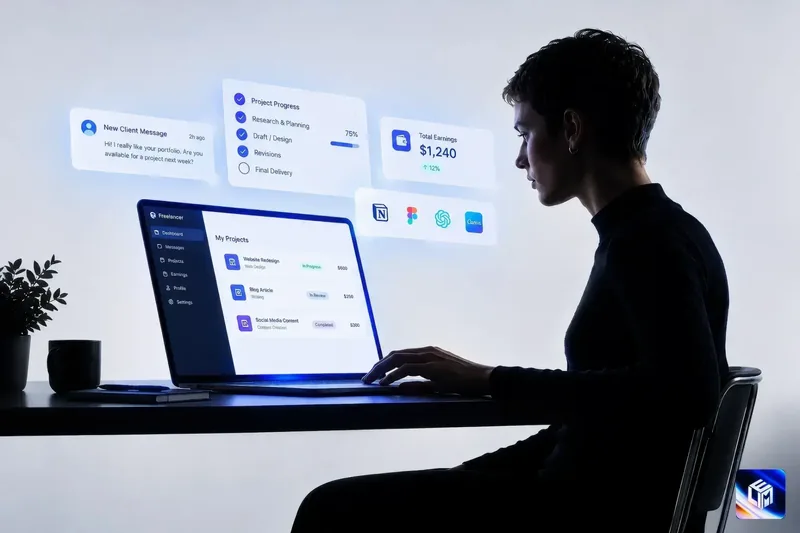
Freelancing means offering your skills to clients without being a permanent employee of one company, and it works in four steps: you find clients, agree on the project, complete the work, and get paid. You might write blog posts for a business, edit videos for a creator, or design websites for small companies. Instead of a regular salary, you get paid for the projects you deliver.
You get more control over your clients, services, and schedule. You're also responsible for finding clients, setting prices, managing payments, and handling taxes. Think of it as running a small service business: clients hire you to solve a specific problem, and both sides agree on what you'll deliver, when, and for how much.
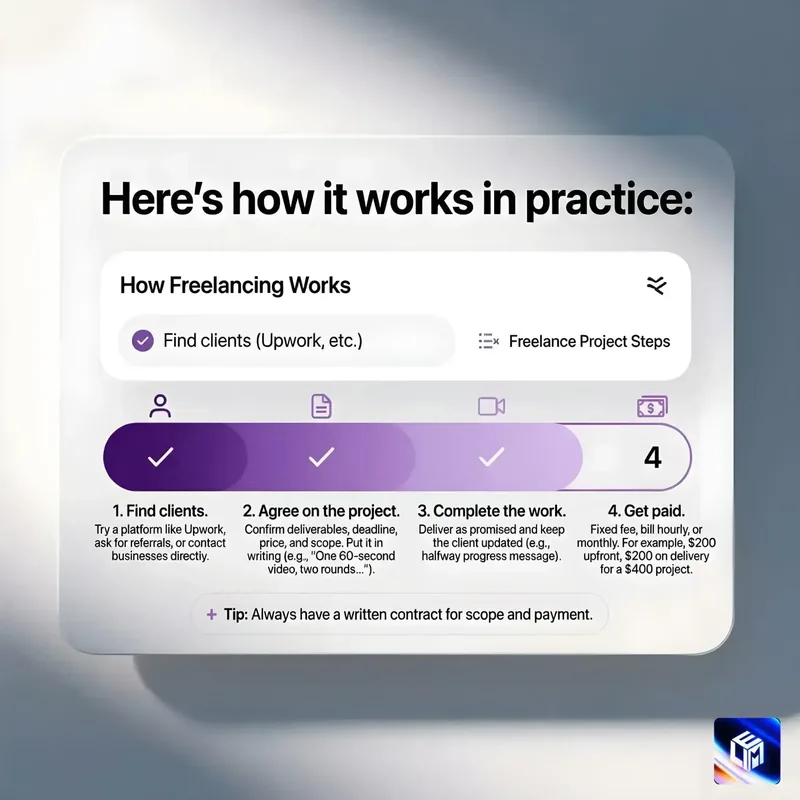
Here's how it works in practice:
- Find clients. Try a platform like Upwork, ask people you know for referrals, or contact businesses directly.
- Agree on the project. Confirm the deliverables, deadline, price, and what falls outside the scope, and put it in writing. For example: "One 60-second video, two rounds of revisions included, extra rounds billed separately."
- Complete the work. Deliver what you promised and keep the client updated. A short progress message at the halfway point means no surprises on delivery day.
- Get paid. You might charge a fixed project fee, bill hourly, or agree on a monthly payment. On a $400 project, for instance, you could ask for $200 upfront and $200 on delivery.
I personally recommend agreeing on payment terms before you start, charging half upfront and half on completion, and favoring fixed fees over hourly rates so clients know the total cost. These are preferences, not guarantees against late payment.
Some projects are one-offs, while others lead to ongoing work. If a business pays you monthly for regular work, that's called a retainer. For example, a company might hire you for one blog post and later pay you each month for content.
You'll also come across a few basic documents:
- Portfolio: examples of your work
- Proposal: your approach and price
- Contract: the agreed scope, deadline, and fee
- Invoice: a request for payment
- NDA: a confidentiality agreement, when needed
Freelancer and author Shreya Pattar also points out that a signed contract doesn't guarantee payment, and an invoice is only a request, so it helps to agree on terms before you start work.
You don't need to master the business side before you start. Build a useful skill, create a few examples of your work, and learn the rest as you go.
The Pros and Cons of Freelancing
The biggest pros of freelancing are control over your clients and schedule, low startup costs, and the chance to start before you quit. The biggest cons are unpredictable income, no employer benefits, and a constant search for new clients. Here's how to weigh them before you commit.
The pros
- You choose your clients and schedule. You pick the projects you take, set your own hours, and can work from home or almost anywhere with a laptop and an internet connection. Because you work online, you're also not limited to your local job market.
- Startup costs are low, and income can grow. Most people begin with equipment they already own and free tools, and you don't need a formal qualification to get hired. Some skills, like video editing or design, need paid software. As your results improve, you can raise your rates instead of waiting for an annual review.
- You can start before you quit. Freelance writer Scott Stockdale spent 18 months building his business alongside a full-time job. Before leaving, he wanted a year of savings, at least $2,000 a month in online income, one steady client, and a reliable way to find new ones. Those were his personal conditions, not a universal rule, but testing the business while still employed lowers the risk. Check your employment contract first to make sure freelancing doesn't conflict with it.
The cons
- Income can be unpredictable. Stockdale followed a record-breaking month with a slow one, when two clients he thought were steady stopped replying. He credits his savings for getting him through. One good month doesn't mean the next one is safe.
- There are no employer benefits. There's no paid leave or sick pay, and your income is taxable. Shreya Pattar recommends speaking to a tax accountant about how this works where you live.
- Finding clients never stops, and early offers can be poor. Even experienced freelancers keep prospecting. Stockdale, for example, aimed for around ten applications a week at one stage. Beginners also meet lowball offers and requests for free work, and Pattar advises walking away from any client who asks you to pay a "security deposit" to be hired.
Freelancing doesn't look like it does on social media, with the calm music and the color-graded desk setup. Most of the work is quiet and repetitive, and some weeks are slow. The people who last are the ones who keep showing up and keep reaching out when things go quiet.
So is it worth it? Freelancing suits people who can handle some uncertainty and enjoy running their own small business. If you're unsure, start on the side, build a financial buffer, and weigh it against your current situation before you decide.
How to Start Freelancing with No Experience: Step by Step
You can begin with no experience in four steps: choose one skill, build three to five samples, find your first client, and turn every project into proof. Aim to finish one paid job first.
Step 1: Choose one skill and make it specific
"Follow your passion" is shaky advice for a beginner. Alex Hormozi argues that passion often follows skill: people tend to love what they've become good at. So run three quick tests instead.
- Interest: You don't need to love it. If you find a skill even about 20% interesting, that's enough to start, because enjoyment usually grows as your results improve. Spend about ten hours on real work, not tutorials, to check.
- Money: Search your skill on X, creator communities, and job boards. If posts mention a budget, people are paying.
- Competition: Skip crowded $10 gigs. A focused niche you understand has fewer rivals.
Common skills to start with:
- Writing and language: copywriting, blog writing, proofreading, translation
- Design and video: video editing, graphic design, UX/UI design, voice-over
- Web and marketing: web design, no-code app building, SEO, social media management
- Support: virtual assistance
- AI-related (add on top of one above): AI clipping, AI automation, GEO (helping brands show up in AI answers)
Pick one, then write a one-line offer: who you help, what you do, and what changes for them. "I edit short-form videos for fitness coaches so they can post daily without filming more" beats "video editor." You can widen your niche later.
Step 2: Build three to five samples and a simple portfolio
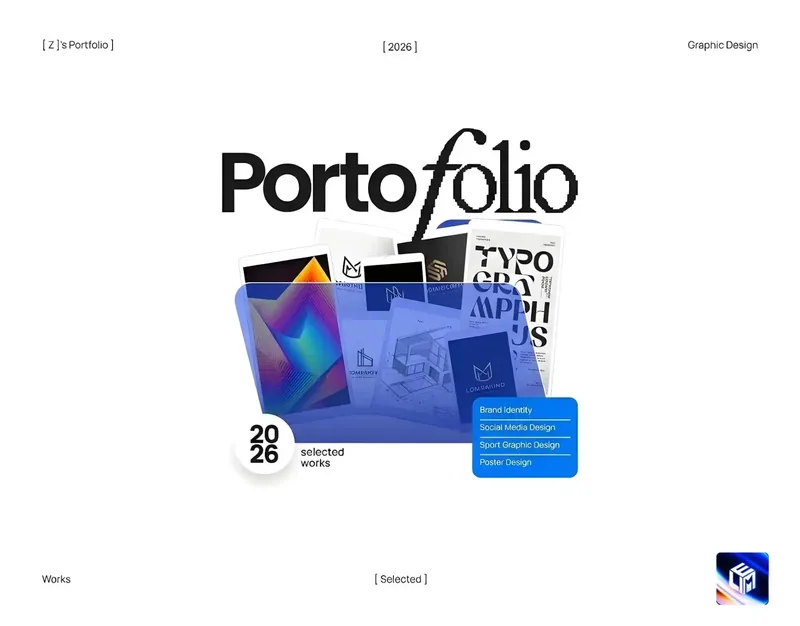
Most beginners think a portfolio means showing everything. But visitors skim and decide fast. The finished work gets you noticed, and your thinking gets you hired. Ask what your ideal client is looking for, then choose quality over quantity: three to five strong pieces is plenty.
With no clients, create samples for an imaginary business (Shreya Pattar's suggestion), recreate a creator's video as a practice piece labeled clearly as a concept, or help a friend and get written permission to show the result.
Then arrange it so a stranger can follow it:
- Headline: say what you do and who you help, with a quick teaser, so visitors know they're in the right place.
- Problem first: set up the situation before the result.
- Your reasoning: explain key decisions in a line or two. For example: "The original ran four minutes with long pauses; I cut it to 45 seconds and added captions for viewers watching on mute."
- Curiosity: share enough to intrigue, and save the full story for a call.
- One next step: a button to book a call or send a message.
Put your best piece first, and swap out your weakest when you have a better project instead of adding a sixth.
Step 3: Go find your first client
Don't wait to be discovered. Start with people you know: Pattar suggests listing 10-15 contacts who could use your service and messaging them first. Then send a few personal messages a week to prospects, mentioning something specific about their work. The next section covers outreach in detail.
Step 4: Turn every project into proof
After each job, ask the client three quick questions: what the problem was, what it was like working with you, and what changed. Their answers become your testimonial, so ask permission to publish it. Then write a 150-word case study: the problem, what you did, and the result. Keep results honest: "she went from posting once a week to three times" counts, and a made-up result can destroy your credibility.
How to Find Your First Freelance Clients
You can find your first freelance clients by messaging 10 to 15 people you know, following up on days 3, 5, and 7, and then testing one channel, such as Upwork, Reddit, Facebook groups, or Quora, in week two. Here's the two-week plan.
Days 1-2: Build your list and your message
Freelancer and author Shreya Pattar suggests listing 10-15 people in your network who could use your service, or who might know someone who could. Then write one message with three parts: a personal line, a short introduction with proof, and one easy ask. Don't quote a price. For example:
"Hi Sara, I watched your last three Reels. The deadlift one had a great hook, but the intro on the squat video took a few seconds to get going. I edit short-form videos for fitness coaches, and I made a 20-second example of how I'd tighten it. Want me to send it?"
It shows you paid attention and asks for a small yes, not a job.
Days 3-7: Send, follow up, and track
Message your list, and follow up around days 3, 5, and 7, adding something useful each time, like a relevant sample. Keep a simple spreadsheet with name, date contacted, and status. Judge yourself on messages sent, not replies received, because silence isn't rejection.
Week 2: Try one channel for strangers
Pick one place, count your replies, and only then decide whether to switch:
- Upwork: Crowded, but Scott Stockdale treats it as a fair starting point. Read each project closely, tailor every proposal, and check Upwork's current rules before sharing contact details.
- Reddit: Good for seeing where your ideal clients ask for help. Many communities ban self-promotion, so read the rules and answer questions first.
- Facebook groups: They show who needs help, but rates are often low. Help first, and don't cold-message strangers.
- Quora: Slow but steady. Detailed answers build trust over time, not quick clients.
On any channel, lead with value. A short sample made for a business you'd like to work with beats a generic pitch.
When someone replies
Ask one or two questions about their goals before you pitch, then show a similar result. Favor clients who reply quickly and give clear feedback, since they produce testimonials fast.
After your first win
Once a client has seen your work succeed, ask: "Do you know anyone else who could use this?" Ask for one introduction at a time, and let them know when it leads somewhere. You can also ask who else in their circle, like a vendor or accountant, might benefit, and tell similar businesses what you just did for that client.
Pick one method, stay consistent, and plan tomorrow's messages tonight so you start without deciding.
How Can AI Help You as a Freelancer?
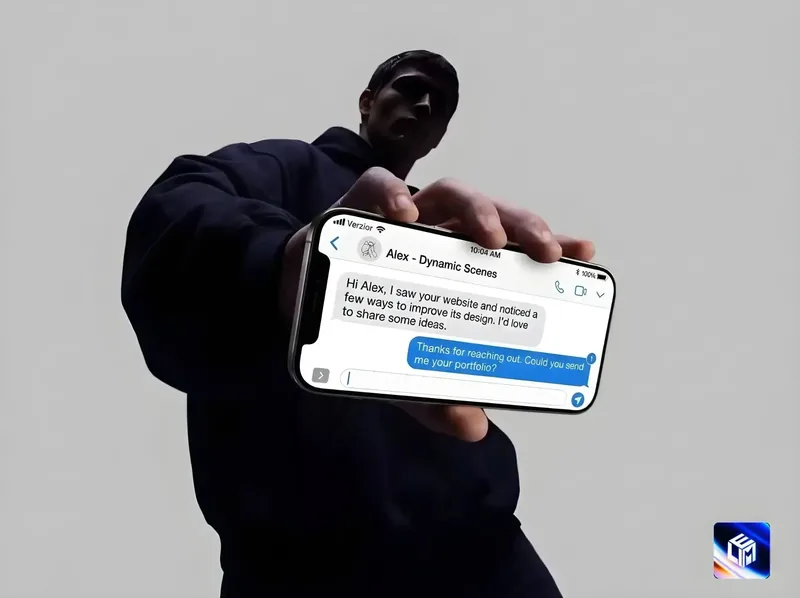
AI helps freelancers research prospects, draft pitches, and handle paperwork, but clients still pay for your decisions. Upwork's 2026 research found that freelancers doing AI-related work earned 34% more per hour on average. But not all AI work pays well: generative AI and creative production contracts grew 90% year over year, while average earnings per contract fell 13%. In short, AI squeezes routine work, and clients pay for judgment.
Where AI saves you time
- Researching a prospect. Paste in their website and ask: "Summarize what this business does and suggest three things I could improve for them." Use the answer to write one specific line in your message, and check it against the source first.
- Drafting your pitch. Ask for a rough first version, then rewrite it in your voice. Give it two or three samples of your best work and ask for several options to compare, so the draft sounds like you.
- Showing before you build. Ask for a rough outline or mockup to confirm direction with a client before you spend hours on the real thing.
- Handling paperwork. Turn meeting notes into action items, draft a polite reply when a request goes beyond the agreed scope, and flag unusual contract clauses like unlimited revisions, broad ownership transfers, or long payment terms. It isn't a lawyer, so get legal advice for anything big.
- Staying organized. Set follow-up reminders and keep a simple pipeline so leads don't go cold.
What to keep for yourself
AI can give you ten options. Choosing the right one is the job. That means understanding what the client actually needs, deciding what's worth including, fixing what the tool gets wrong, and building the relationship. That's where your value sits.
In my own work, the biggest win was speed. AI saved me time on routine tasks and caught grammar mistakes in my writing, but I still read everything myself before sending it to a client.
Three rules to follow
- Review everything. You're responsible for what the client receives, so check facts, code, and anything they'll see.
- Protect client files. Don't paste confidential material into a tool without checking the client's rules, since it could break an NDA. Follow any client or platform rules on AI use.
- Do it by hand first. Automate a task only after you've done it manually a few times.
Try one this week: pick a single task, like researching a prospect, and test it on your next outreach message.
Conclusion: Start Small, Build Your Skills, and Find Your First Client
Learning how to start freelancing with no experience comes down to a few steps in the right order: choose one skill, build a few samples, and reach out to people who need your help. Don't wait until you feel ready. Today, write down 10 people or businesses you could message this week.
Your first goal isn't to become a successful freelancer overnight. It's to give someone a good reason to hire you.
FAQs
Can I start freelancing with no experience?
Yes. Clients mostly care whether you can do the job, not your résumé. Pick one skill, build three to five samples (for an imaginary business if you have no clients), and finish one paid job first. I personally think that first project teaches you more than a perfect logo or website.
Which freelance website is best for beginners?
Upwork and Freelancer.com are common starting points, but no single platform suits everyone. Upwork is competitive, but it can still be a good place to find your first clients. Reaching out to people you already know can sometimes be faster than competing with hundreds of freelancers online.
How long does it take to get your first freelance client?
There is no fixed timeline; landing a first freelance client depends on niche clarity, portfolio samples, and outreach volume. If I were you, I would message 10 to 15 people I know first, follow up on days 3, 5, and 7, then try Upwork, where the platform's guide advises narrowing your niche and linking work samples in every proposal. I would track results for several weeks before changing approach.
How much do freelancers make?
Freelance earnings vary by skill, niche, and experience. Upwork lists average rates of about $15-$40 per hour for writers and editors, and $15-$50+ for web developers. Rates vary by source and experience, so compare several guides. For more hourly rates, check Upwork's guide.
Is freelancing still worth it in 2026?
Yes, if you have a clear skill and can show results, but it isn't easy money. Routine, low-cost work faces the most pressure from AI, and income can swing, so start on the side and build a buffer first. Weighing other options? See our guide to the 17 best ways to make money online.
What's the easiest freelance job for beginners?
The easiest freelance jobs for beginners depend on you, but common starting points include writing, proofreading, video editing, graphic design, social media management, and virtual assistance. Choose a skill you don't dread, that people already pay for, and that you can learn within a few months. Test it with about ten hours of real work.