
There are more ways to make money online than ever—and that can make getting started confusing.
Freelancing, affiliate marketing, digital products, e-commerce, YouTube, software… The options are endless. The real problem isn't a lack of opportunities; it's knowing which one makes sense for you.
Too many options can leave you stuck comparing side hustle ideas instead of taking action.
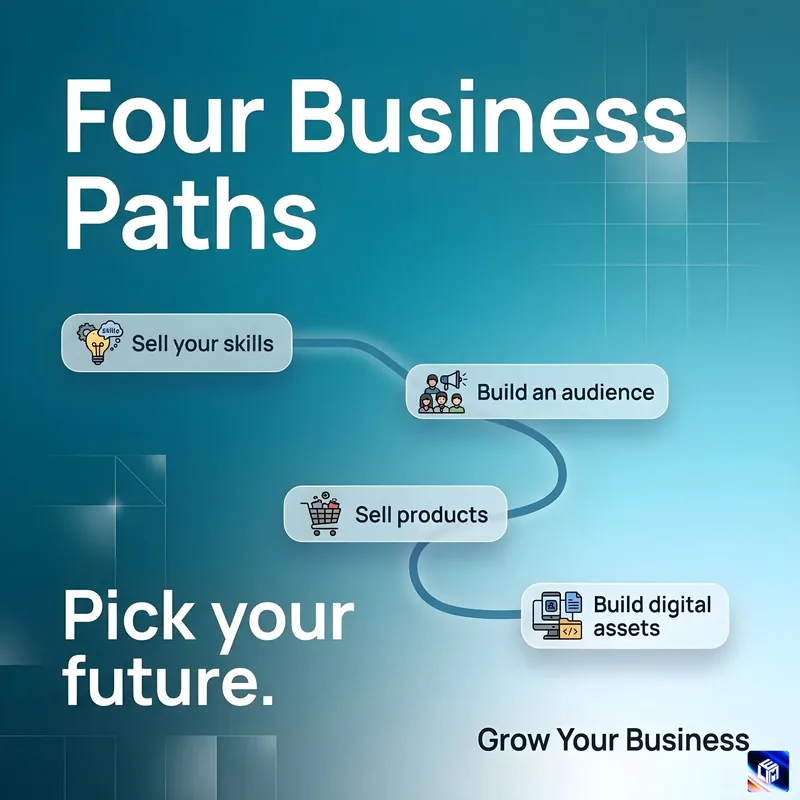
That's why this guide breaks down 17 practical ways to make money online in 2026, organized into four categories: selling skills, building an audience, selling products, and building digital assets.
For each method, you'll see how it works, what it takes, who it may suit, and its main challenge.
You don't need all 17.
You just need to find one realistic place to start.
PART 1: SELL YOUR SKILLS
If you already have or are willing to develop a useful skill, selling it can be a straightforward way to start an online business.
You don't need inventory or a large audience to make money online. Identify a problem, learn and demonstrate how you can solve it, and get paid for that.
Here are eight ways to do it.

1. Freelancing
Freelancing means working independently and getting paid by clients for specific services instead of being permanently employed by one company. Popular skills include writing, design, programming, marketing, translation, and video editing.
Step-by-step
Step 1: Choose a skill
Pick something you enjoy learning that people already pay for. Be specific. For example, offer short-form video editing for social media creators instead of simply calling yourself a video editor.
Step 2: Build a small portfolio
Make three to five strong samples. If you have no clients yet, recreate a real creator's video, help a friend with a project, or take a small beginner job through a freelance platform. Quality beats quantity.
Step 3: Go find clients
Don't wait to be discovered. Pick one or two places where your ideal clients spend time and send a few personal messages each week. Mention something specific about their work and explain where you think you could help.
Step 4: Turn every project into proof
When a job ends, ask for a testimonial and save the before-and-after. A short case study showing what you changed and why can be more convincing than a long bio.
Best for: People who want to turn a skill into income without making a product or holding inventory.
Main challenge: Finding steady clients is harder than learning the skill. Clients pay for better results and good judgment, not software knowledge, so show both in your samples and pitches.
Start with proof, not profit. Every project builds your skills and portfolio, making the next client a little easier to win.
2. Copywriting
Copywriting is persuasive writing used to advertise a product, service, or business and persuade the reader to take a particular action.
Copywriting differs from standard writing because it directly relates to performance. You can write advertisements, emails, landing pages, product descriptions, video scripts, and much more.
Step-by-step
Step 1: Learn what makes copy persuasive
Study headlines, offers, and how people make decisions. Focus on benefits, not just features: “10-hour battery” is a feature; “no more hunting for a charger” is the reason to care. Then study the ads you see every day and ask what each one wants you to do.
Step 2: Practice by breaking down real copy
Rewrite advertisements, write sample emails, create landing-page sections, and compare your version with the original. Pay attention to the headline, promise, benefits, proof, and call to action.
Step 3: Choose a specialty
You could focus on email, direct response, e-commerce, B2B, SEO-related content, or another area. A specialty gives you a clearer type of client to study and pitch.
Step 4: Build a portfolio and find clients
Put your best samples where clients can see them. Then pitch, apply, deliver great work, and use feedback to keep improving.
Best for: People who like writing, persuasion, psychology, and business.
Main challenge: Building credibility without much client experience. Strong rewrites and a clear specialty help because they show how you think before you have many testimonials.
Copywriting can begin as a freelance service and later connect naturally with consulting, education, digital products, or your own business.
3. Video Editing
Video editing is the process of organizing and refining multiple clips into a polished final composition. But strong editing requires more than knowing which buttons to press.
The real skill is understanding story, pacing, emotion, sound, and the viewer's experience.
Step-by-step
Step 1: Choose editing software
Make sure your computer can handle it, then commit to one tool long enough to get comfortable. Premiere Pro, DaVinci Resolve, and Avid are all established options.
Step 2: Learn the why, not just the buttons
Study composition, dialogue, sound, music, pacing, and visual storytelling. Don't just learn how to add an effect. Ask why an editor would use it and whether it actually improves the scene.
Step 3: Study edits you already enjoy
Take videos you think are well edited and watch them more closely. Notice where cuts happen, how long shots stay on screen, how sound changes the mood, and how the edit keeps your attention.
Step 4: Build a portfolio around the work you want
Make a few practice projects and show only your best. Want short-form work? Make short-form samples. Want long-form YouTube? Show that instead.
Step 5: Find clients and keep practicing
Define your service clearly, communicate deliverables, approach potential clients, and use each project to improve your editing and workflow.
Best for: Creative people who enjoy storytelling and visual communication.
Main challenge: Clients aren't only paying for software skills. They're paying for your judgment and a better finished video.
If you enjoy creative work but don't want to be the person on camera, video editing gives you another way to participate in the content economy.
4. AI Video Clipping
AI video clipping turns long videos like podcasts, interviews, and webinars into short clips for Shorts, TikTok, and Reels. AI can find highlights and add captions in minutes, but it can't tell which moment will make someone stop scrolling. That's your job.
Demand is strong: 49% of marketers name short-form video their top-ROI format, according to HubSpot's 2026 State of Marketing data. But since anyone can clip now, your edge is picking better moments.
Step-by-step
Step 1: Pick content you understand
Fitness coaches, business podcasts, gaming streams, whatever you already follow. If you know the subject, you'll spot good moments faster than any tool.
Step 2: Study why clips work
Skip the view counts. Look at how a clip opens, how fast it moves, and what kept you watching.
Step 3: Hunt for the moment
Good clips usually hide in a surprising claim, a good story, a heated disagreement, or a question that makes you want the answer. Learn to hear them in a two-hour recording.
Step 4: Let AI do the grunt work, then fix it
Use tools for highlights, captions, and reframing. Then watch every clip yourself and fix anything that feels flat, confusing, or badly timed.
Step 5: Make samples and pitch
Create a few strong clips and send them to creators and brands. A finished clip next to the raw recording sells itself.
Best for: People who like video, social media, and spotting what makes content interesting.
Main challenge: AI has made basic clipping easy, so your edge is choosing better moments and making them hard to scroll past.
Reality check: Skip the income hype. Study creators with strong long-form content, find the moments that could work as shorts, and build original samples that show your judgment.
5. Social Media Management
Businesses often want a stronger social media presence but don't have enough time to plan content, publish consistently, engage with their audience, and understand what's actually working.
That's where social media management can become a service.
Step-by-step
Step 1: Learn what makes a social account useful
Study content strategy, platform basics, audience research, analytics, branding, and social media marketing. Pay attention to why some posts create discussion or action while others disappear without much response.
Step 2: Research a real business
Pick a business and study its audience, offer, competitors, existing content, and social presence. Look for obvious gaps instead of creating random posts just to practise.
Step 3: Build the skills around the strategy
Practise writing captions, creating content calendars, basic design, storytelling, and analysing performance. Copywriting and AI-assisted workflows can also make your service more useful.
Step 4: Turn your work into a portfolio
Create a few examples of content plans or mock campaigns based on real businesses. Show the thinking behind the posts, not just screenshots of attractive designs.
Step 5: Find businesses with a clear content problem
Look for businesses where you can explain what isn't working and what you would improve. A specific observation is usually more useful than a generic message saying you can “manage their social media.”
Best for: Creative people who enjoy content, communication, research, and marketing.
Main challenge: Showing businesses that your work contributes to meaningful goals rather than simply producing more posts.
The goal isn't to become another person who schedules content. A valuable social media manager understands the business, its audience, its offer, and what each piece of content is supposed to accomplish.
You can start with one specific service and expand as your skills and experience develop.
6. SEO & GEO Services
SEO & GEO services help businesses become easier to discover, understand, and surface across search engines and AI-powered platforms.
Instead of simply creating more content, you identify visibility gaps—places where potential customers are searching, but the business is difficult to find or understand.
Step-by-step
Step 1: Learn the fundamentals
Study keywords, search intent, site structure, technical SEO, and how AI-powered search and answer systems find and interpret information. GEO is still an evolving area, so focus on understanding the principles rather than memorising one fixed formula.
Step 2: Choose a client niche
Focus on a type of business you understand so you can recognize its audience, competitors, and opportunities.
Step 3: Find opportunities
Look for missed searches, unclear content, weak structure, or limited visibility across search and AI platforms.
Step 4: Practice and improve
Apply what you learn, test changes, and refine your approach based on what you observe.
Step 5: Measure results
Track search performance, website behavior, and relevant visibility indicators to improve your strategy.
Best for: Analytical people who enjoy research, writing, websites, AI, and problem-solving.
Main challenge: Search and AI systems constantly evolve, so you must keep learning, testing, and adapting.
Businesses need more than content. They need to be discoverable, understandable, and useful wherever potential customers search.
7. AI Website Design
AI website design means using AI tools to help create websites faster and more easily. These tools can generate the layout and content, so you can build a professional website without needing much coding experience.
Step-by-step
Step 1: Learn basic website design
Understand website structure, user experience, design principles, and what makes a website useful to visitors.
Step 2: Define the website's purpose
Before opening an AI tool, determine who the website is for, what the business needs to communicate, and what visitors should do next. A website should solve a business problem, not simply look impressive.
Step 3: Research and gather inspiration
Study high-quality websites in your industry. Look at their structure, layout, navigation, visuals, and calls to action to guide your design.
Step 4: Build with AI, then edit like a human
Use an AI website-building tool to create the initial structure, then review and refine the result. Tools such as Lovable and Replit can speed up parts of the process, but the output still needs human judgment.
Step 5: Build a portfolio and find clients
Create sample projects, show the problems you solved, and approach businesses that need a better online presence.
Best for: People interested in design, websites, business, and AI tools.
Main challenge: Generating a site is easy. Making one that communicates clearly and gets visitors to act is the real skill.
Personal note: This is one of the faster skills to pick up because you don't need deep technical knowledge. I built LearnEarnMindset® in 2 to 3 months, and what got it done was following the steps and staying consistent.
8. AI App Development
AI app development uses AI-assisted tools to build apps that solve useful problems.
You don’t have to start by building a huge software company. Solving one specific problem with a focused app is a better solution.
Step-by-step
Step 1: Identify a problem
Identify a particular group of people that wants to improve a repetitive, frustrating, expensive, or time-consuming task.
Step 2: Define the minimum viable version
Make a list of the things the app must do and the things that can wait. Don't add features just because it's easy to build them with an AI tool.
Step 3: Choose an AI-assisted development tool
Choose a tool that fits the type of application you want to create. Learn its core capabilities and limitations before relying on it for a real project.
Step 4: Build, test, and break the first version
Create the core functionality, then test it with different inputs and realistic situations. Look for errors, confusing interactions, and places where the app doesn't behave as expected.
Step 5: Watch real people use it
Ask a few potential users to try it, and notice where they get stuck. They'll find problems you stopped seeing.
Step 6: Turn it into proof
Document the problem, your solution, and how you built it. Use it as a portfolio piece or keep improving it into a real product.
Best for: Problem solvers who enjoy technology, experimentation, and building things.
Main challenge: Building an application is very different from building something people actually want to use.
AI can reduce some technical barriers, but product thinking, testing, persistence, and choosing the right problem still matter.
PART 2: BUILD AN AUDIENCE
The previous eight methods focus on selling a skill directly.
The next three work differently.
Instead of selling your time or expertise to clients, you can build an audience through useful content and eventually monetize the attention and trust you've earned.
These methods are attractive to people who enjoy creating rather than doing client work.
9. Affiliate Marketing
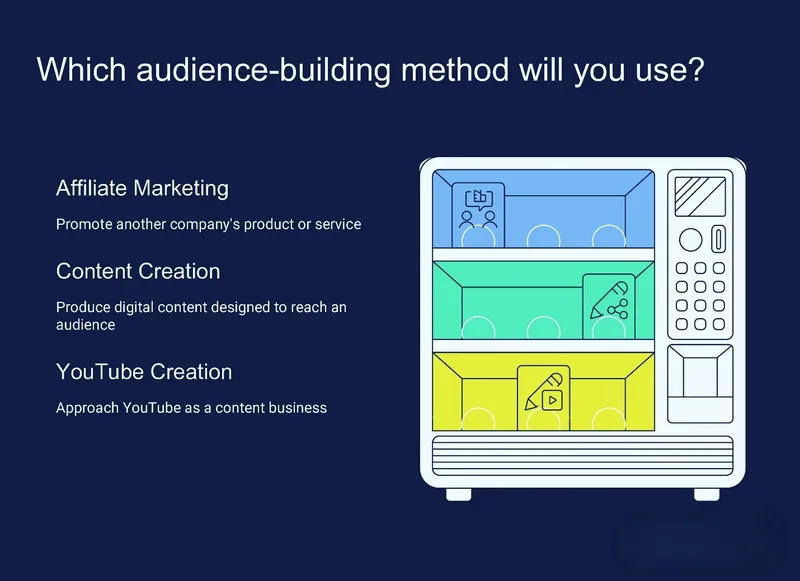
Affiliate marketing allows you to promote another company's product or service as a side hustle and earn a commission when your referral generates a qualifying sale or action.
You don't have to create the product yourself, but you do need a reason for people to trust your recommendation, especially if you want to build an income stream from your content.
Step-by-step
Step 1: Choose a niche
Choose a topic you genuinely enjoy where people already research and purchase products or services.
Step 2: Choose your platform
A blog, YouTube channel, or newsletter. One done well beats three half-built.
Step 3: Join programs for products you'd actually recommend
Check commission rates, how long a referral count, and payout terms. If you wouldn't buy it, don't promote it.
Step 4: Create content that helps someone decide
A comparison of three budget mics with a clear pick beats a page of links. Use the product first.
Step 5: Track and improve
Monitor clicks, conversions, commissions, and content performance. Improve what works and remove what doesn't.
Best for: People who enjoy content, research, recommendations, and audience building.
Main challenge: High competition, and you generally need useful content and audience trust before it becomes meaningful.
Affiliate marketing isn't simply about adding links everywhere. The stronger approach is to help someone make a better buying decision.
10. Content Creation
Content creation involves producing videos, articles, images, podcasts, newsletters, social posts, or other digital content designed to reach an audience.
The content itself isn't necessarily the business. It can become the asset that attracts attention and creates opportunities for monetization and passive income.
Step-by-step
Step 1: Pick a narrow topic and a specific audience
"Personal finance for freelancers" gives people a reason to follow you. "Lifestyle" doesn't.
Step 2: Start on one platform
Go where your audience already spends time, and learn what that platform rewards.
Step 3: Share what you're learning
You don't need to be an expert. Document what you try, what works, and what doesn't.
Step 4: Commit to a schedule you can keep
Two posts a week for six months beats daily posting for two weeks. Repurpose each piece into other formats.
Step 5: Watch what people react to
Notice what gets saved, shared, and replied to, then make more of it.
Best for: People who like explaining ideas and are fine improving in public.
Main challenge: Staying consistent while growth is slow. Most people quit before it compounds.
As your audience develops, potential monetization routes include sponsorships, affiliate offers, services, memberships, courses, and digital products.
11. YouTube Content Creation
YouTube can be approached as a content business rather than simply a place to upload videos.
You don't necessarily need to appear on camera, but a channel still needs original, useful, engaging content that gives viewers a reason to watch.
Step-by-step
Step 1: Choose a clear audience and topic
Decide who you're creating for and what type of videos they should expect from your channel.
Step 2: Develop a repeatable content format
Choose video formats you can realistically produce, such as tutorials, explanations, reviews, commentary, demonstrations, or educational videos.
Step 3: Research topics
Study what your audience is interested in and identify questions or problems you can address.
Step 4: Build a production system
Decide how research, scripting, recording, editing, thumbnails, and publishing will be handled.
Step 5: Publish, measure, and improve
Study audience response and improve your topics, presentation, titles, thumbnails, and videos.
Best for: People who enjoy video, storytelling, research, or teaching.
Main challenge: Building a sustainable production system is more important than simply uploading a few videos.
PART 3: SELL PRODUCTS
If you don’t want to sell your time directly, you can create or sell products.
This includes physical, customized, knowledge, and educational products.
The trade-off? Product businesses require you to handle things like research, fulfilment, distribution, customer experience, and product-market fit.
12. Dropshipping
Dropshipping is an e-commerce model where you sell products without keeping the inventory yourself. When a customer orders, a supplier fulfils the order.
The model can reduce the need to hold large amounts of inventory, but it doesn't remove the work involved in running a business.
Step-by-step
Step 1: Educate yourself
Learn how dropshipping works, including product research, suppliers, pricing, fulfilment, customer service, and marketing.
Step 2: Choose a niche and products
Find a focused market and research products that solve a genuine problem or satisfy a clear desire.
Step 3: Research suppliers
Compare quality, pricing, shipping, communication, policies, and customer experience. Order samples when practical.
Step 4: Build and market the store
Create clear product pages, policies, payment options, and marketing content.
Step 5: Track and improve
Study sales, conversion rates, costs, refunds, customer feedback, and other relevant numbers.
Best for: People interested in e-commerce, marketing, and product research.
Main challenge: Getting products in front of customers profitably while maintaining a good customer experience.
You may have heard people say, “Dropshipping is dead.” But people still buy products online. What has changed is the approach: treat dropshipping as a real retail business, not a shortcut to easy money.
13. Amazon FBA
Fulfillment by Amazon (FBA) is a model where sellers send inventory to Amazon, and Amazon handles certain fulfilment activities for eligible orders.
It can simplify logistics, but you still manage products, suppliers, pricing, listings, inventory, and the business economics.
Step-by-step
Step 1: Research what to sell
Study demand, competition, reviews, pricing, fees, costs, and potential margins.
Step 2: Set up your seller account
Understand Amazon's requirements, fees, policies, and fulfilment terms.
Step 3: Find and evaluate suppliers
Compare quality, costs, minimum orders, shipping, communication, and reliability.
Step 4: Create the product listing
Use accurate information, useful images, and clear descriptions.
Step 5: Plan inventory and launch
Send inventory using the Send to Amazon workflow, then monitor sales, costs, stock, reviews, and customer feedback.
Best for: People interested in physical products and e-commerce operations.
Main challenge: Inventory creates financial risk, so product research and cash-flow planning matter.
Unlike freelancing, you're building around a product and inventory system rather than primarily selling your time.
14. Print-on-Demand
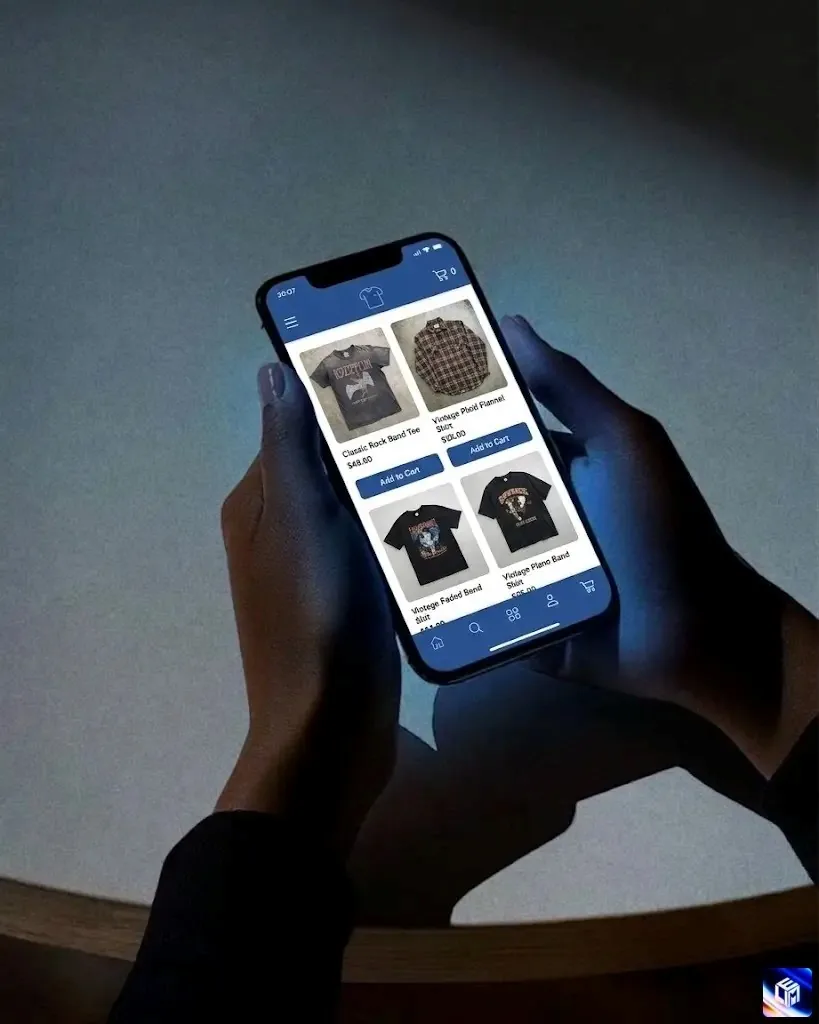
Print-on-demand lets you sell customized products such as shirts, mugs, posters, and notebooks without buying large quantities of inventory in advance.
The product is produced when an order is placed through your chosen provider.
Step-by-step
Step 1: Choose a specific niche
Identify an audience, hobby, profession, community, or interest you understand.
Step 2: Research and create original designs
Study what your audience cares about and develop designs that are relevant rather than simply copying popular products.
Step 3: Choose a print provider
Compare product quality, printing, shipping, fulfilment, costs, and customer support.
Step 4: Create your store and promote it
Add products, write clear descriptions, use good images, and build a strategy to reach potential buyers.
Step 5: Test and improve
Study which products perform well and improve your designs, positioning, selection, and marketing.
Best for: Designers, creators, and people who understand a particular audience.
Main challenge: Getting customers to care about your designs can still be difficult, even without holding inventory.
The advantage of print-on-demand is that you don't need to purchase large amounts of inventory before knowing whether a product will sell. But that doesn't remove the need for good product ideas, strong designs, effective positioning, and marketing.
15. Digital Products
Digital products are products customers can purchase and receive online instead of receiving a physical item.
Examples include templates, e-books, study guides, planners, spreadsheets, prompts, and digital guides.
Step-by-step
Step 1: Find a specific problem
Look for something people want to learn, organize, create, or accomplish more easily.
Step 2: Choose the right format
Turn the solution into a practical product such as a guide, checklist, AI template, prompt, or e-book.
Step 3: Create something genuinely useful
Make it clear, practical, and easy to use. More pages or features don't automatically create more value.
Step 4: Show people why it's useful
Create content around the problem your product solves so potential customers understand its value.
Step 5: Sell, collect feedback, and improve
Listen to customer questions and feedback and update the product where appropriate.
Best for: People with knowledge, skills, research, systems, or creative abilities they can package.
Main challenge: Creating the product is only part of the business. Distribution still matters.
A major advantage is that you can create a product once and sell it repeatedly, creating a potential income stream without producing or shipping each order. However, you still need to provide real value and find the right audience.
16. Online Courses
Online courses let you package knowledge into a structured learning experience instead of exchanging your time for every individual lesson.
A good course doesn't need hundreds of hours of material. It needs to help a specific student make meaningful progress toward a specific outcome.
Step-by-step
Step 1: Choose your topic and student
Identify what you can teach and exactly who would benefit from learning it.
Step 2: Brain-dump and structure your knowledge
Write down everything you could teach, then organize it into clear topics and subtopics.
Step 3: Create and edit the course
Produce your lessons and add useful examples, exercises, demonstrations, or other learning materials.
Step 4: Publish and share your course
Choose an appropriate platform, launch your course, and make your target audience aware of it.
Step 5: Learn from students
Study questions, feedback, engagement, completion, and areas where students struggle.
Best for: People with knowledge or experience they can teach clearly.
Main challenge: Knowing something isn't the same as knowing how to teach it.
The strongest course idea is usually not “everything I know about X.”
It's a focused solution to a specific learning problem.
PART 4: BUILD DIGITAL ASSETS
The final method is different.
Instead of selling hours, products, or content, you're building an asset that can potentially retain value beyond a single transaction.
That doesn't make it easier. It often requires more judgment and patience.

17. Micro-SaaS
Micro-SaaS is a small software business designed to solve one specific problem for a specific group of people.
You don't need to begin by building a huge platform. A focused product can be built around a narrow task that people repeatedly experience.
Step-by-step
Step 1: Find one real problem
Look for a repetitive, frustrating, expensive, or time-consuming task that a specific group wants to make easier.
Step 2: Design a focused solution
Define the smallest useful product that solves the problem.
Step 3: Create a basic version
Build an MVP—Minimum Viable Product—that real users can test.
Step 4: Get your first users
Let a small group use the product and observe where they struggle, what they value, and whether they keep using it.
Step 5: Improve and monetize
Fix the biggest problems, keep improving, and introduce a paid model when the product provides enough value.
Best for: People interested in software, products, problem-solving, and systems.
Main challenge: Finding a problem people care enough about to solve and pay for.
Micro-SaaS works when you find a real problem, validate it fast, stay focused, and build software people value enough to keep paying for.
Final Takeaway
You don't need to try all 17 ways to make money online.
And you don't need to find a secret website, tool, or business model that suddenly makes passive income easy.
You need to find a starting point that matches what you have and what you're willing to develop.
If you have a skill, consider selling it.
If you enjoy creating, consider building an audience.
If you understand a problem, consider creating a product.
If you enjoy technology, consider building a digital solution.
If you enjoy research and markets, consider exploring digital assets.
Then choose one.
Learn it. Practice it. Put your work in front of real people. Pay attention to what happens. Improve.
And if you noticed, all 17 methods have something in common: you will make mistakes. Learn from them, improve, and stay consistent.
The goal of this guide isn't to convince you that one method is universally better than another.
It's to make the decision less confusing.
You don't need the perfect online business. You need a realistic place to start.
FAQ
What is the Best Way for Beginners to Make Money Online in 2026?
There is no single best method. Start with a realistic option that matches your skills, interests, available time, and resources.
How long does it take to start earning money online?
It depends on the method, your skills, consistency, and hard work. Some services can generate income relatively quickly, while audience-based businesses usually take longer.
Do you need money to start making money online?
You don't necessarily need money to start making money online. Freelancing, copywriting, content creation, and some digital products can be started with little or no upfront investment.